Aaron Wey MD, FAAOS, FACS · Adult and Pediatric Spine Surgery870 Palisade Ave, Teaneck, NJ · (201) 836-1663 · aaronweymd.com
Anterior Knee Pain in Teens (Patellar Tendonitis and Sinding-Larsen-Johansson)
Description
Pain at the front of the knee is the most common knee complaint I see in teenagers, and most of it comes from one small area: the bottom tip of the kneecap and the thick tendon that runs from it down to the shin. In a growing child, the pain is usually in the growth center at the tip of the kneecap, which is called Sinding-Larsen-Johansson syndrome. In an older teenager whose growth center has hardened into bone, the same stress irritates the tendon itself, which is patellar tendonitis, or "jumper's knee." They are the same problem at two different ages, and they are treated the same way.
Two close relatives cause pain nearby: Osgood-Schlatter disease, at the bump on the shin where the tendon ends, and pain from the cartilage under the kneecap itself (patellofemoral pain), which is more of a diffuse ache around and behind the kneecap. This guide covers the tendon and its growth center; the treatment overlaps a great deal.
How it happens (the mechanism)
The thigh muscle (quadriceps) straightens the knee by pulling on the kneecap, which pulls on the patellar tendon, which pulls on the shin. Every jump, sprint, kick, and landing sends that pull through the tip of the kneecap. In a growing child, that tip is a soft cartilage growth center rather than hard bone, and it is the weakest link in the chain.
The problem is almost always tightness. During a growth spurt the bones lengthen faster than the muscles, so the quadriceps becomes relatively short and pulls harder at rest and with every stride. Add a season of jumping or running, and the growth center or the tendon becomes inflamed where the pull concentrates. A tight quadriceps is the cause, and a loose one is the cure; that is why stretching, not rest alone, is the center of treatment.
Symptoms
- Pain and tenderness right at the lower tip of the kneecap, or just below it in the tendon. The teenager can usually point to it with one finger.
- Worse with jumping, running, squatting, kneeling, stairs, and after sitting with the knee bent for a long time.
- Better with rest; stiff and sore the morning after a hard practice.
- Mild swelling or a small firm bump at the tip of the kneecap in long-standing cases.
- Usually one knee, sometimes both, in an active child during or just after a growth spurt.
Doctor examination and imaging
The exam makes the diagnosis: tenderness at the tip of the kneecap or in the tendon, a tight quadriceps (the heel cannot reach the buttock when the child lies on the stomach), and often tight hamstrings and calves too. I check the kneecap's tracking, the hips, and the alignment of the leg, because weak hip muscles and knock-knee add to the load. X-rays are not usually needed, but I use them when the pain is unusual, after an injury, or when a small chip at the kneecap tip needs to be told apart from a fracture. An ultrasound or MRI is reserved for pain that does not respond.
Treatment
Stretch the quadriceps, every day. This is the treatment. The regimen is simple, and it only works if it is done consistently:
- Hold each stretch for 20 seconds.
- Do 5 rounds on each side.
- That is 100 seconds of stretch per side, each session.
- Twice a day: once in the morning or before practice (after a few minutes of warm-up), and once in the evening.
- A pull in the front of the thigh is right. Pain at the kneecap means the pull is too hard: ease off.
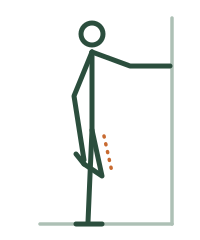
Standing stretch. Stand tall with one hand on a wall. Bend the sore knee and hold the foot (or the ankle) behind you with the other hand. Keep the knees together and the hips pushed forward; do not let the knee drift out to the side or the back arch. Hold 20 seconds. Switch sides. Repeat for 5 rounds each.
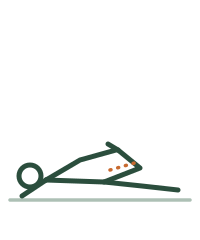
Side-lying stretch. Lie on your side with the sore leg on top. Bend the top knee and hold the foot, pulling the heel toward the buttock while pushing the hip forward. Keep the knees together. This version is easier to control and is the one I suggest for younger children and anyone who finds balance hard.
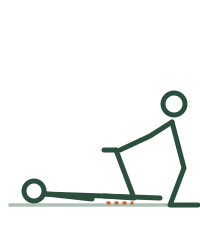
With a parent's help. For a smaller child, have them lie on their stomach. Bend the knee slowly with one hand on the ankle and the other resting on the low back, until the child feels a pull in the front of the thigh. Hold 20 seconds, release, and repeat. Never push through pain, and never bounce.
The rest of the plan.
- Stretch the hamstrings and calves daily as well, since they share the load. My quadriceps, hamstring, and calf stretching printouts show how.
- Keep playing as the pain allows. Cut jumping and sprinting volume for two to four weeks if pain is limiting, and build back gradually. Complete rest is rarely needed and is not the fix.
- Ice at the tip of the kneecap for 10 to 15 minutes after activity.
- A patellar strap worn just below the kneecap during sport takes some pull off the tip and helps many teenagers.
- For patellar tendonitis in an older teen, add slow squats on a slanted board (eccentric decline squats), 3 sets of 15, once a day, which strengthen the tendon.
- Strengthen the hips: clamshells, side-lying leg raises, and bridges, three times a week, so the knee stays in line on landing.
- An anti-inflammatory for a few days during a flare is fine; it is not a long-term plan. Injections into the tendon are avoided in growing athletes.
Surgery is essentially never needed. The rare exception is a tendon that remains painful well into adulthood after years of proper treatment.
Recovery and long-term outlook
Sinding-Larsen-Johansson resolves as the growth center hardens into bone, usually within a year or two, with no lasting harm to the knee. Patellar tendonitis settles over six to twelve weeks of stretching and load management in most teenagers. The stretching habit is what prevents it from returning with the next season or the next growth spurt.
When to call the doctor
Call if the pain follows a single injury or a pop, if the knee cannot be straightened fully or the child cannot lift the leg straight, if there is a lot of swelling, if the knee is hot or red, if there is a fever, or if things are not improving after six weeks of daily stretching.
Learn more
OrthoInfo (AAOS), Osgood-Schlatter Disease: orthoinfo.aaos.org (opens in a new tab)
My guides to Sinding-Larsen-Johansson syndrome, Osgood-Schlatter disease, and the quadriceps stretching printout.
This information is for educational purposes only. It is not a substitute for professional medical advice, diagnosis, or treatment. For specific concerns about your child, consult a board-certified, fellowship-trained pediatric orthopaedic surgeon.
More for families
OrthoKids · POSNA
POSNA's OrthoKids: illustrated, family-friendly information on this condition.
Open on OrthoKids (opens in a new tab)